
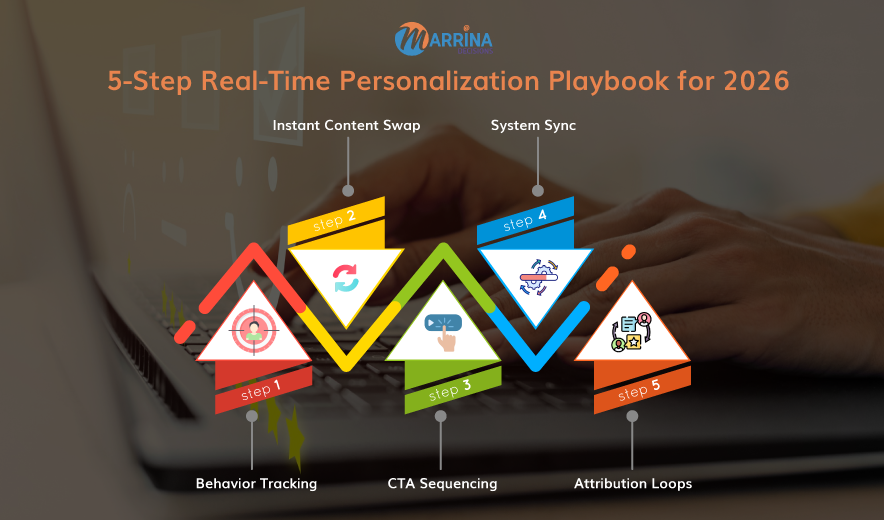
Real-Time Personalization Readiness: Your 5-Step Playbook for 2026
Why Real-Time Personalization Matters Now (Enterprise Context)
Real-time personalization has existed in marketing conversations for over a decade. What has changed heading into 2026 is not the concept itself, but the cost of getting it wrong.
For years, enterprises treated personalization as a batch-driven enhancement layered on top of static journeys. Weekly segmentation refreshes, delayed behavioral scoring, and rule-based content swaps were considered “good enough.” That model no longer holds.
Three structural shifts have made real-time personalization a business requirement rather than an optimization:
First, buyer behavior has compressed. Enterprise buyers now move between research, validation, and vendor comparison in shorter, less predictable bursts. Intent signals emerge and decay within hours, not weeks. When systems respond slowly, relevance collapses before engagement even begins.
Second, AI-driven decisioning depends on immediacy. Modern personalization engines, predictive models, and journey orchestration tools are only as accurate as the freshness of the signals they ingest. Delayed or stale behavioral data corrupts model outputs, leading to misrouted journeys, mistimed CTAs, and unreliable scoring.
Third, GTM velocity has become a competitive differentiator. Enterprises are no longer competing solely on product differentiation. They are competing on how quickly and accurately their systems respond to buyer intent across web, email, and sales-assisted touchpoints.
In this environment, real-time personalization is not about showing different headlines to different users. It is about aligning behavior, content, and action at the moment intent is expressed.
When real-time systems are missing or poorly implemented, the failure patterns are consistent:
- High-intent users see generic content because systems cannot react fast enough
- CTAs fire out of sequence, creating friction instead of momentum
- Sales teams receive alerts after intent has already cooled
- Attribution models misinterpret delayed engagement as disinterest
- AI engines learn from outdated or incomplete behavioral patterns
The result is not just lower conversion. It is systemic inefficiency across marketing, sales, and RevOps.
By 2026, real-time personalization readiness defines whether an organization’s MarTech stack is:
- Signal-driven or assumption-driven
- Predictive or reactive
- Revenue-accelerating or revenue-delaying
This playbook is designed to help enterprise teams evaluate and build that readiness — not as a feature rollout, but as an operational capability spanning data, systems, content, and attribution.
Step 1: Behavior Tracking — Capturing Signals That Actually Matter
Real-time personalization fails most often at the very first layer: behavior tracking.
Not because enterprises lack data, but because they collect the wrong signals, at the wrong resolution, with the wrong latency.
By 2026, behavior tracking is no longer about volume. It is about signal fidelity.
Why Most Enterprise Behavior Tracking Breaks Down
Enterprise stacks typically suffer from one or more of the following structural issues:
- Events are tracked, but not normalized across systems
- Web, email, product, and sales signals live in separate timelines
- Behavioral data is processed in batch windows, not streams
- Tracking focuses on vanity actions instead of decision-driving behaviors
This creates a false sense of visibility. Dashboards look full, but personalization engines operate on delayed, incomplete, or misclassified inputs.
When that happens, downstream systems fail in predictable ways:
- Content swaps trigger too late
- Journey branches misfire
- AI models overweight low-intent actions
- Sales alerts arrive after engagement has peaked
The issue is not tooling. It is a tracking strategy.
What “Real-Time” Behavior Tracking Actually Means in 2026
In an enterprise context, real-time does not mean millisecond-level response everywhere. It means near-immediate availability of intent signals at decision points.
Effective real-time behavior tracking focuses on three categories of signals:
1. Intent-Weighted Actions
Not all behaviors deserve equal treatment. High-performing systems prioritize:
- Pricing page depth and return frequency
- Demo, trial, or documentation engagement patterns
- Content sequencing (what was viewed after what)
- Repeated engagement within compressed time windows
Tracking page views alone is insufficient. Tracking behavioral progression is what enables relevance.
2. Contextual Signals
Behavior without context is misleading. Real-time readiness requires pairing actions with:
- Device and environment context
- Entry source and campaign alignment
- Account-level behavior aggregation (for B2B buying groups)
Without context, personalization engines optimize for isolated clicks instead of buying intent.
3. Temporal Signals
Timing is as important as action. Systems must distinguish between:
- One-off curiosity
- Sustained research
- Accelerating intent
A user who views three assets in ten minutes is signaling something very different than a user who does the same over three weeks. Real-time systems must preserve that distinction.
Operational Requirements:
To support real-time personalization, behavior tracking must meet specific operational criteria:
- Event standardization across web, email, product, and sales touchpoints
- Low-latency ingestion into MAP, CDP, or decisioning layers
- Clear ownership of event definitions and maintenance
- Governance controls to prevent event sprawl and degradation
Most importantly, tracking must be designed backward from personalization decisions, not forward from analytics curiosity.
The question is not:
“What can we track?”
It is:
“What behavior must our systems recognize immediately to change the next experience?”
If that question cannot be answered clearly, real-time personalization will remain aspirational, not operational.
Step 2: Instant Content Swap — Making Experiences Respond Without Delay
Once behavior is captured correctly, the next failure point emerges quickly: content does not move at the speed of intent.
Many enterprise teams believe they have real-time personalization because content is “dynamic.” In practice, most content systems are still pre-rendered, batch-evaluated, or manually constrained, making real-time response impossible even when the signal is available.
Why Instant Content Swap Breaks in Enterprise Environments
Content delivery fails to respond in real time due to structural constraints, not creative ones. Common issues include:
- Personalization rules that evaluate only at session start
- CMS or MAP templates that cannot re-render mid-journey
- Overreliance on pre-built segments instead of live conditions
- Manual content approvals that freeze dynamic logic
The result is a lag between intent recognition and experience change. When that lag exists, personalization becomes cosmetic rather than functional.
A high-intent visitor still sees:
- Generic homepage modules
- Awareness-stage messaging
- CTAs designed for first-time visitors
By the time content updates, the moment of relevance has passed.
What “Instant” Really Means for Content in 2026
Instant does not require full-page regeneration on every action. It requires modular content architecture that can respond independently at critical points.
Effective real-time content systems are built around:
1. Modular Experience Components
Rather than entire pages being personalized, high-performing teams focus on:
- Hero modules
- Value proposition blocks
- Proof points and customer logos
- CTA panels
These components can swap based on live behavior without disrupting page stability or performance.
2. Decision-Layer Separation
Content logic should not live inside creative assets. It should live in:
- A decisioning layer (CDP, rules engine, or orchestration tool)
- Governed logic that evaluates live conditions
- Reusable rules that apply across channels
This separation allows teams to adjust logic without rebuilding content.
3. Latency-Aware Delivery
Content systems must account for:
- Cache behavior
- CDN delays
- Browser rendering constraints
If content takes seconds to update, it is no longer real-time in a buyer’s journey. Performance is a personalization requirement, not an engineering afterthought.
Operational Requirements:
To enable instant content swap at enterprise scale, teams must establish:
- Component-based design systems that support dynamic replacement
- Pre-approved content variants mapped to intent stages
- Clear escalation rules for when content should upgrade or downgrade
- Testing frameworks that validate swaps under real traffic conditions
Most failures at this stage occur because teams attempt to personalize everything. Real-time systems succeed by personalizing what matters most, exactly when it matters.
When content responds immediately to intent, buyers experience continuity rather than friction. When it does not, even the best behavior tracking becomes irrelevant.
Step 3: CTA Sequencing — Aligning Actions With Buyer Readiness
If real-time personalization stops at content, it remains incomplete.
The most expensive failures occur when calls-to-action lag behind intent.
CTA sequencing is where many enterprise personalization efforts quietly underperform. The content may be relevant, but the action requested is not. This mismatch creates friction at the exact moment momentum should increase.
Why CTA Sequencing Fails at Scale
In most enterprise environments, CTAs are:
- Hard-coded into templates
- Tied to static funnel stages
- Governed by campaign calendars rather than buyer behavior
As a result, users are often asked to:
- “Learn more” after demonstrating high intent
- “Request a demo” before sufficient context is established
- Re-submit forms they already completed
- Navigate backward in the journey
This is not a messaging issue. It is a sequencing issue.
When CTAs are misaligned, systems generate false signals:
- High-intent users disengage
- AI interprets hesitation as disinterest
- Attribution models misclassify stalled progression
- Sales teams receive mixed readiness indicators
What Real-Time CTA Sequencing Looks Like in 2026
By 2026, CTAs must operate as adaptive decision points, not static buttons.
Effective CTA sequencing systems account for:
1. Behavioral Readiness
CTAs should respond to:
- Cumulative engagement depth
- Acceleration of activity
- Prior conversions and commitments
A user who has already consumed technical documentation should not see the same CTA as a first-time visitor.
2. Journey History
Sequencing must respect:
- Completed actions (downloads, signups, trials)
- Previous CTA exposure
- Sales touchpoints and CRM activity
Repetition signals poor system memory and erodes trust.
3. Risk Management
Not every user should be escalated immediately. Real-time systems must also:
- De-escalate CTAs when signals cool
- Pause progression during inactivity
- Reintroduce education when confidence drops
This prevents premature sales engagement and protects pipeline quality.
Operational Requirements:
Enterprise-ready CTA sequencing requires:
- State-aware CTA logic shared across web, email, and product
- Persistent user context stored outside individual channels
- Rules that prioritize progression, not volume
- Sales alignment so CTAs reflect actual handoff readiness
The objective is not to push users forward as quickly as possible. It is to pull them forward when the system is confident.
When CTAs evolve in real time with buyer readiness, friction disappears. Engagement becomes directional. Attribution becomes cleaner. Sales conversations begin at the right depth.
Step 4: System Sync — Aligning CRM, Marketing Automation, and Web in Real Time
Real-time personalization collapses the moment systems fall out of sync.
By the time most enterprises reach this step, they discover the uncomfortable truth: the bottleneck is no longer content or logic, but infrastructure alignment.
Web experiences, marketing automation platforms, and CRMs often operate on different clocks, different data models, and different assumptions about the buyer. When those systems disagree, personalization degrades into inconsistency.
Why System Sync Is the Hardest Step
Most enterprises did not design their stacks for real-time coordination. Common structural gaps include:
- Web behavior updating instantly, while MAPs refresh on delays
- CRM data overwriting more recent behavioral signals
- CDPs aggregating data faster than downstream systems can consume it
- Sales activity existing outside the marketing decision loop
These misalignments create contradictory experiences:
- The website upgrades messaging while email remains generic
- Sales outreach ignores recent digital behavior
- Personalization logic conflicts across channels
- Attribution models assign credit inconsistently
In these environments, “real-time” becomes channel-specific rather than system-wide.
What Real-Time System Sync Means in 2026
By 2026, real-time personalization requires shared state awareness across systems. Not perfect immediacy everywhere, but coordinated responsiveness at decision points.
Effective system sync relies on three principles:
1. Single Source of Truth for Intent State
Enterprises must define where buyer readiness lives:
- Not inside individual tools
- Not duplicated across systems
- But maintained in a central decision layer
This intent state should update based on behavior, sales activity, and lifecycle progression — and be readable by all execution systems.
2. Bi-Directional Data Flow
One-way sync is insufficient. Real-time systems require:
- Web → MAP → CRM updates
- CRM → MAP → Web feedback
- Sales actions influencing personalization logic
Without bi-directional flow, systems operate on outdated assumptions and personalization logic fractures.
3. Latency Tolerance Mapping
Not all systems need to update at the same speed. High-performing teams map:
- Which decisions require sub-minute updates
- Which can tolerate short delays
- Which should never be overwritten automatically
This prevents data conflicts while preserving responsiveness.
Operational Requirements:
To achieve reliable system sync, enterprises must implement:
- Clear data ownership rules across MAP, CRM, CDP, and web
- Conflict resolution logic for overlapping updates
- Change management controls to prevent regressions
- Cross-functional alignment between Marketing Ops, RevOps, and Sales Ops
Most failures at this step occur when teams attempt to “connect everything” without defining decision authority.
Real-time personalization is not about perfect synchronization. It is about consistent interpretation of intent, regardless of channel or system.
When systems agree, experiences feel coherent. When they do not, even advanced personalization creates confusion instead of clarity.
Step 5: Attribution Loops — Teaching Systems What Actually Works
Real-time personalization does not improve on its own.
Without feedback loops, systems repeat assumptions instead of learning from outcomes.
Attribution is where most real-time strategies quietly stall. Enterprises invest in tracking, content logic, and orchestration — but fail to close the loop between personalized action and business result. When that happens, systems cannot distinguish effective personalization from noise.
Why Attribution Breaks in Real-Time Environments
Traditional attribution models were not designed for real-time decisioning. Common breakdowns include:
- Attribution windows that lag behind real-time actions
- Credit models that ignore in-session personalization changes
- Disconnected web, email, and sales attribution frameworks
- Overreliance on last-touch or channel-based credit
In these conditions, systems cannot answer critical questions:
- Which content swap actually influenced progression?
- Which CTA sequence accelerated readiness — and which stalled it?
- Which real-time decisions improved pipeline quality versus volume?
When attribution fails, optimization becomes subjective. Teams debate outcomes instead of improving systems.
What Attribution Loops Must Do in 2026
By 2026, attribution is not about assigning credit for reporting. It is about feeding learning back into decision engines.
Effective real-time attribution loops perform three functions:
1. Decision-Level Tracking
Attribution must capture:
- Which personalized decision was made
- Under what conditions
- At what point in the journey
This allows systems to correlate decisions with downstream impact, not just exposure.
2. Outcome-Based Feedback
Rather than optimizing for clicks or impressions, real-time attribution must evaluate:
- Progression velocity
- Stage advancement quality
- Sales acceptance and conversion integrity
This prevents systems from optimizing for shallow engagement.
3. Model Reinforcement
Attribution data should inform:
- Personalization rules
- AI weighting and scoring logic
- CTA sequencing thresholds
Without reinforcement, AI systems drift or overfit to outdated patterns.
Operational Requirements:
Enterprise attribution loops require:
- Unified measurement frameworks across web, MAP, CRM, and sales
- Event tagging tied to decisions, not just assets
- Clear success definitions aligned with revenue outcomes
- Governance processes to review and recalibrate logic regularly
The goal is not perfect attribution. It is directional learning at scale.
When attribution loops function correctly, real-time personalization becomes self-improving. When they do not, teams remain stuck tuning rules without knowing which changes matter.
Real-Time Personalization Maturity Self-Assessment (2026)
By this stage, most enterprise teams recognize a critical truth: real-time personalization is not a binary capability. It exists on a maturity curve shaped by systems, governance, and execution discipline.
This self-assessment is designed to help marketing, RevOps, and GTM leaders evaluate where their organization truly stands — not where tools suggest they should be.
Level 1: Reactive Personalization
Characteristics
- Personalization driven by static segments
- Content swaps evaluated at session start or campaign launch
- CTAs hard-coded into templates
- Attribution focused on channel-level reporting
Operational Reality
Systems react after the fact. Intent signals are captured, but not acted on quickly enough to influence outcomes. Personalization exists, but relevance decays before it matters.
Risk
Teams overestimate readiness while AI and attribution models quietly degrade.
Level 2: Conditional Personalization
Characteristics
- Rule-based content swaps tied to defined behaviors
- Limited real-time web personalization
- Partial CRM and MAP alignment
- Manual optimization cycles
Operational Reality
Some responsiveness exists, but decision logic is fragile. Changes require human intervention, and personalization coverage is inconsistent across channels.
Risk
Scaling personalization increases operational debt faster than performance gains.
Level 3: Coordinated Personalization
Characteristics
- Centralized intent definitions
- Modular content architecture
- CTA sequencing informed by journey state
- Shared data models across web, MAP, and CRM
Operational Reality
Systems begin to agree. Experiences feel coherent across touchpoints. Attribution starts informing optimization rather than reporting alone.
Risk
Without automation and reinforcement loops, gains plateau.
Level 4: Adaptive Personalization
Characteristics
- Near-real-time signal ingestion
- Decision-level attribution
- AI-informed content and CTA logic
- Bi-directional system sync
Operational Reality
Personalization adapts continuously. Systems learn from outcomes. GTM velocity improves without sacrificing pipeline quality.
Risk
Requires strong governance to prevent drift and over-optimization.
Level 5: Predictive Personalization (Enterprise-Ready)
Characteristics
- Unified intent state powering all channels
- Real-time orchestration across web, email, sales
- Attribution loops reinforcing AI models
- Governance embedded into workflows
Operational Reality
Personalization becomes infrastructure, not a feature. Experiences anticipate needs rather than react to actions. Revenue systems operate with confidence instead of guesswork.
Advantage
Higher conversion quality, faster sales cycles, cleaner data, and reliable AI outputs.
What This Means for 2026 GTM Leaders
Real-time personalization readiness is no longer measured by tool capability. It is measured by system coherence.
Enterprises that win in 2026 will not be the ones with the most advanced features. They will be the ones whose systems:
- Recognize intent quickly
- Respond consistently
- Learn continuously
- Scale without friction
This playbook is not about transformation for its own sake. It is about ensuring that when intent appears, your organization is structurally capable of acting on it.
The Strategic Next Step
Most enterprises do not fail at real-time personalization because they lack ambition. They fail because readiness spans too many systems to solve in isolation.
Marketing leaders work with Marrina Decisions when they recognize that real-time personalization is not a campaign upgrade — it is a Marketing Ops, MarTech, and GTM execution challenge.
We help enterprise teams:
- Assess real-time personalization readiness across web, MAP, CRM, and CDP
- Design behavior tracking and decision frameworks that scale
- Build modular, real-time content and CTA systems
- Align attribution with AI-driven optimization
- Establish governance that sustains performance
If your goal is to make real-time personalization operational, reliable, and revenue-driven in 2026:
👉 Request support: https://marrinadecisions.com/contact-us